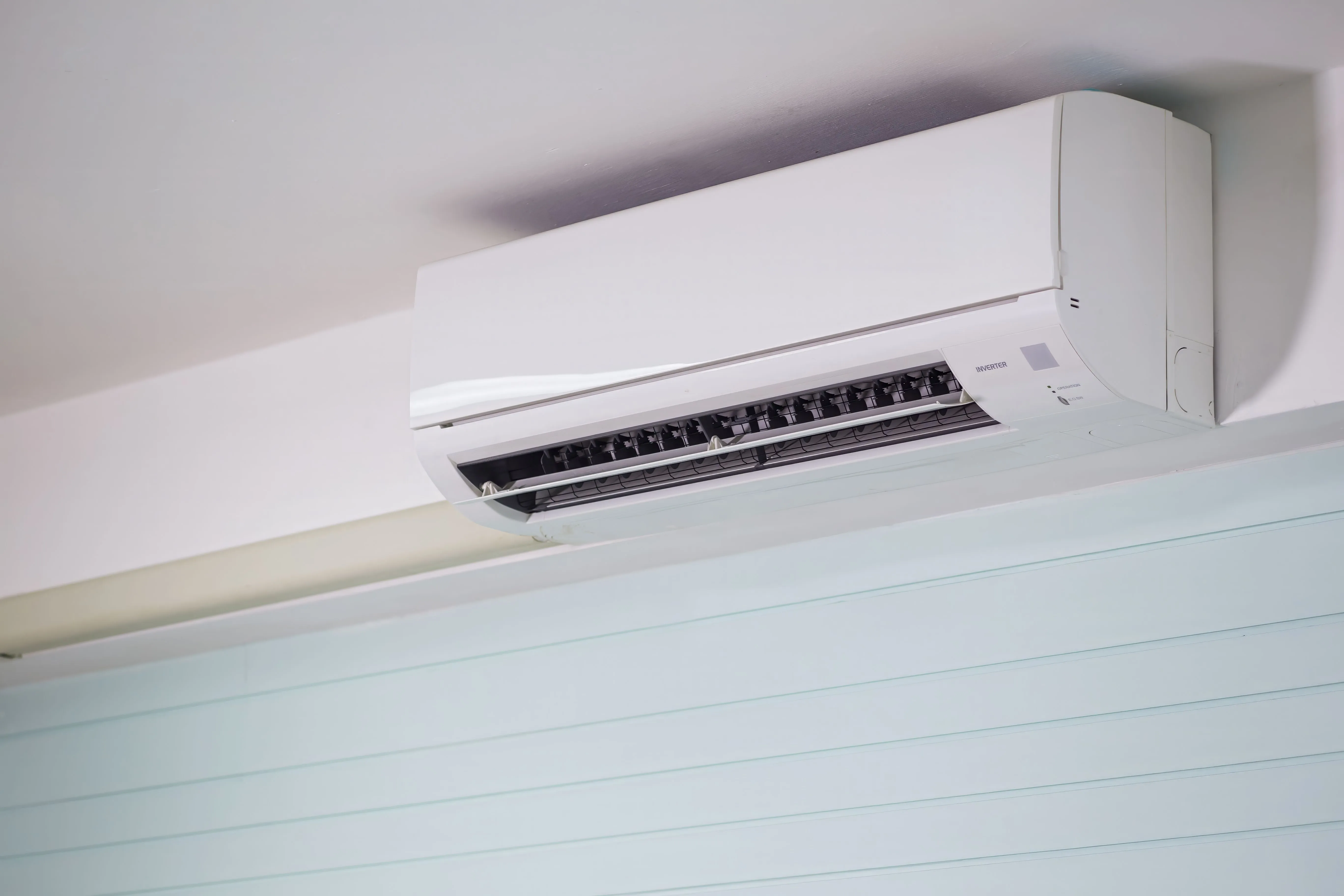
Energy-Efficient AC for a Large Villa in Dubai: Tonnage, Inverter vs Non-Inverter & What to Buy (2026 Guide)
Quick answer: The most energy-efficient AC for a large villa in Dubai is a correctly sized inverter system with a 4 or 5-star UAE energy label, built to handle high outdoor temperatures. It can be a central ducted unit, a VRF system or a set of inverter splits, depending on your villa. The size matters as much as the brand, so get it from a heat load calculation, not a guess.
Chill Air handles AC supply and installation, ducted split AC servicing and annual maintenance contracts in Dubai.
Key Facts at a Glance
What Makes an AC Energy-Efficient?
Three things: how well the unit turns electricity into cooling, whether it can slow down once the house is cool, and whether it's the right size. Brand names matter less than those three.
Efficiency shows up on the MOIAT energy label, which is mandatory on air conditioners sold in the UAE. It gives a star rating from one to five and the unit's annual energy use in kWh. That kWh figure lets you compare two units of the same capacity before you buy. The original UAE standard for household splits and window units tests them in hot conditions (46°C outdoors), so the stars reflect Gulf summers, not a mild European one.
On spec sheets you'll also see EER and SEER. Higher is better. Daikin's UAE villa guide suggests looking for a SEER of 14 or above.
Our advice for a villa that runs most of the day for months: go for 4 or 5 stars. A 3-star unit meets the rules, but it costs more to run year after year.
Inverter vs Non-Inverter AC: Which Is Better for a Villa?
Inverter is better for the rooms you use every day. An inverter compressor changes speed to match the heat in the room. A non-inverter compressor runs at full power, switches off, then starts again.
What the research says. A field test in Istanbul office rooms found inverter savings between 11% and 38%. In a test in Jeddah, an inverter unit averaged about 11.6 kWh a day against 20.8 kWh for a fixed-speed unit, roughly 44% less. Some manufacturers advertise bigger numbers, but those are best-case claims under their own test conditions. We wouldn't budget around them.
Does it pay back? Daikin's villa guide says the higher price of an inverter unit is typically recovered within a few years in the UAE. The longer your AC runs, the faster that happens. A guest room that's cooled for a couple of hours a week won't earn the difference back, so a fixed-speed unit is fine there.
How Many Tons of AC Does a Large Villa Need?
There's no honest single number. It depends on floor area, ceiling height, glass, which way the house faces, insulation and the number of floors. Rules of thumb for a whole house vary a lot from one source to the next, which is why we won't hand you one. What works is sizing room by room, then checking the total with a proper calculation.
A ton of cooling is 12,000 BTU per hour. It measures how much heat the unit removes, not its weight or its size.
A Starting Point for Each Room
Based on LG's UAE sizing guide, written for split units:
Then adjust for the things that make UAE rooms hotter than their floor area suggests:
- West-facing rooms: add about 0.5 ton. The afternoon sun from May to September adds a lot of heat.
- High ceilings: the tables assume about 2.8 metres. Double-height rooms need more.
- Top floor or under the roof: the room starts the day already warm, so size up.
If a room sits right on the border between two sizes, let the sun exposure decide.
A Quick Example
Take a 4-bedroom villa with a master suite, three bedrooms, a living room, a family room and a majlis. Using the table above: 2 + (3 × 1.5) + 2 + 2 + 2.5 comes to about 13 tons on paper. That's the sum of the rooms, not an answer. A proper calculation also looks at orientation, glazing, insulation and the fact that rooms don't all peak at the same time. It's often what separates a right-sized system from an oversized one.
Why Not Just Go Bigger to Be Safe?
Because oversizing is the more common mistake. Abu Dhabi's Department of Energy says UAE air conditioning systems are often oversized by 25% to 35%, and that right-sizing could cut a villa's electricity bill by up to 25%, plus lower the equipment cost (up to AED 56,000 for a villa in their example). That guidance comes from Abu Dhabi and is aimed mainly at new developments, but the physics is the same in Dubai.
An oversized unit also cools the air so fast that it shuts off before it has removed the moisture. You get a room that's cold and a bit clammy. An undersized unit has the opposite problem: it runs flat out and never reaches the temperature you set.
What to ask for: a written heat load calculation for your villa. It turns "about 13 tons" into "this many tons for this house".
Which AC System Is Best for a Large Villa?
If you're not sure which suits your villa, call us and we'll talk it through. We also handle AC ducting works and central A/C maintenance.
What to Look for in a Hot Climate
- A high-ambient (tropical) rating. Many standard units are rated to around 43 to 46°C outdoors. Dubai can go past that in summer, and a unit not built for it may cut out or struggle at the worst moment.
- Corrosion protection on the coils, especially near the coast. Think Palm Jumeirah or Marina.
- Shade and airflow around the outdoor unit. A condenser in full afternoon sun works harder and wears faster.
- Good insulation and glazing. Sometimes upgrading these lets you specify a smaller, cheaper system.
What Does an Energy-Efficient AC Save on a DEWA Bill?
DEWA charges residential electricity in slabs: 23 fils per kWh for the first 2,000 kWh in a month, 28 fils up to 4,000 kWh, 32 fils up to 6,000 kWh and 38 fils above that. A fuel surcharge (6 fils per kWh in July 2026) and 5% VAT go on top. In a big villa the AC pushes you into the higher slabs, so the units you save are the most expensive ones.
Example (illustrative numbers, not a measurement of your home): say your AC uses 3,000 kWh in a hot month. A 30% saving is 900 kWh. Those units fall in the 28-fil slab, so with the surcharge and VAT each one costs about 36 fils. That's roughly AED 320 saved in that month. Over four to six hot months, you're looking at about AED 1,300 to AED 1,900 a year.
Tariffs get reviewed, so check the current rates on DEWA's tariff calculator before you plan around them.
Settings and Upkeep That Protect Your Efficiency
- Set the thermostat to 24°C, on auto if your unit has it. DEWA says each degree lower raises cooling use by around 5%.
- Going out for a few hours? DEWA suggests switching off or setting it to around 27°C.
- Service it twice a year, once before summer and once after. Dirty filters and coils are the quickest way to lose efficiency. Our AC preventive maintenance covers this.
- Consider an annual maintenance contract. We offer annual maintenance contracts for AC in Dubai.
- Know the age. DEWA puts the optimal life of an AC at around 10 years. If yours is older and your bills keep climbing, a new inverter system may cost less over time than keeping the old one going. When a part fails (capacitors, fan motors and compressors are common ones), ask for genuine parts with an invoice and warranty.
Related reading: How Often Should I Service My AC in Dubai? and Why Is My AC Not Cooling Properly?
Checklist Before You Buy
- Ask for a written heat load calculation.
- Choose inverter for every room you use daily.
- Compare the MOIAT label stars and annual kWh on units of the same capacity.
- Confirm the unit is rated for high outdoor temperatures.
- Pick a shaded, ventilated spot for the outdoor unit.
- Get an itemised quote in writing, then compare it line by line.
Frequently Asked Questions
What is the most energy-efficient AC for a large villa in Dubai?
A correctly sized inverter system with a 4 or 5-star MOIAT label and a high-ambient rating. For most large villas that means central ducted or VRF. Inverter splits work well for smaller villas or individual rooms.
How many tons of AC does a large villa need?
It depends on floor area, ceiling height, glazing, orientation and the number of floors, so only a heat load calculation gives a reliable answer. As a starting point, size each room (a standard bedroom of 120 to 180 sq ft usually takes 1.5 ton, a living room 2 ton), then have an engineer check the total.
Is inverter AC worth it in Dubai?
Yes, for rooms you use every day. Independent tests found inverter units used roughly 11% to 44% less electricity than fixed-speed units. The savings grow with running hours, and Dubai's cooling season is long.
Does a 5-star AC really cost less to run?
Usually, yes. The MOIAT label prints the annual kWh, so compare two units of the same capacity and multiply the difference by your DEWA rate.
What temperature should I set my villa AC to in Dubai?
24°C. DEWA says each degree lower raises cooling electricity use by about 5%.
How often should a villa AC be serviced in Dubai?
Twice a year, once before summer and once after. Ducted systems also need their ducts inspected and cleaned from time to time.
Sources